Controlling gambling
How to Control Gambling Spending and Keep to a Limit
A useful limit is decided before gambling begins, covers every account and sits behind stronger protections for essential money.

Quick answer
How to Control Gambling Spending and Keep to a Limit
To control gambling spending, decide the maximum amount before you gamble, measure deposits across every account, protect bills first and stop when the limit is reached without using wins as permission to continue. Add operator limits, bank controls and a rule against repeat deposits. If limits are repeatedly changed, hidden or funded with essential money or borrowing, stopping completely and seeking specialist support is safer than trying to refine the budget.
Key points
- Set the limit before gambling, not after a win or loss changes how you feel.
- Track total money deposited across all operators, accounts and payment methods.
- Treat wins as part of the same session, not as a new spending allowance.
- Use repeated limit-breaking as information that stronger protection is needed.
What does controlling gambling spending actually mean?
Control means the financial rule survives contact with the gambling session. A limit that can be increased after a loss, spread across several accounts or restarted with winnings does not protect the amount you intended to keep.
Choose one measure that is easy to verify. Gross deposits are usually clearer than a net figure because withdrawals and wins can make the cost feel smaller whilst more money continues to move through gambling accounts. Your bank statements and operator histories can help you see the whole pattern.
- Use one weekly or monthly maximum across every gambling account.
- Include cash, e-wallets, bank transfers and repeat deposits, not only card payments.
- Record time and number of sessions as well as money; longer or more frequent play can signal declining control.
- Do not borrow, use credit, delay bills or move money back out of protected accounts to fund gambling.
Set the limit whilst you are calm
Make the decision away from a gambling app and after essential costs have been paid. If the amount would affect rent, mortgage, food, energy, transport, debt payments or people who depend on you, it is not affordable gambling money.
Write the limit as a complete rule: the amount, the period it covers, which accounts it includes, when it resets and what happens when it is reached. Add a no-top-up rule. This removes the most common negotiation: “I will add a little more and stop after the next result.”
Protect essential money before the limit is tested
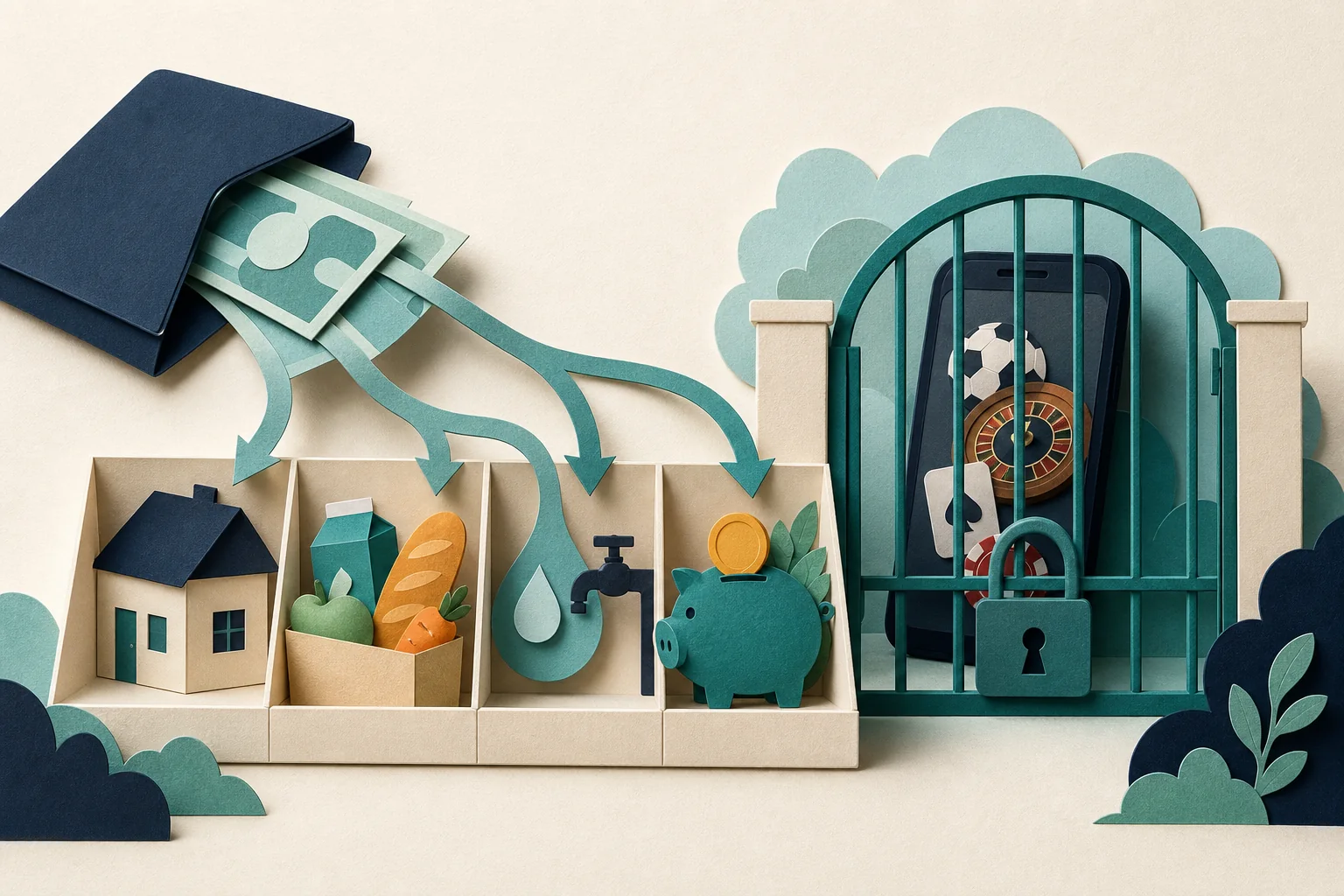
A spending limit should sit behind a household budget, not compete with it. Pay priority bills and move savings on payday. Consider keeping essential money in an account or pot that is not linked to the card or device used for discretionary spending.
Many banks offer gambling-payment blocks, and operators offer time-outs, reality checks and financial limits. These controls are useful even when your goal is to reduce rather than stop because they add friction when an unplanned deposit appears.
Use rules that still make sense during a win or a loss
Losses can produce an urge to recover money; wins can produce a belief that the session is funded by the operator. Both can weaken the original limit. Keep the same stopping rule regardless of the last result.
Avoid live re-deposits. Decide once, make no top-up and leave payment cards outside the room. Use a timer that ends the session rather than one that simply reports how long you have played. If a result makes you angry, excited or desperate to continue, treat that change in state as the stopping signal.
Review behaviour, not just the final balance
At the end of the week, compare your rule with what actually happened. Count total deposits, withdrawals, gambling days, time spent, unplanned top-ups and any attempt to hide or reinterpret the amount. A win does not erase a broken rule.
If the plan worked, identify what made it easier. If it did not, add a barrier rather than only lowering the number again. A bank block, self-exclusion, removal of apps or a period without gambling may be the more useful response.
When is stopping safer than trying to control gambling?
Consider a stop-gambling plan if you repeatedly exceed limits, chase losses, borrow, use bill money, hide transactions, open new accounts after restrictions or feel unable to watch sport or relax without betting. Those patterns show that the limit is no longer containing the behaviour.
You do not need to wait for a particular loss or diagnosis. The National Gambling Helpline can discuss both cutting down and stopping. If debt is involved, use free debt advice alongside gambling support.
Direct answers
Common questions
Can I gamble safely by setting a spending limit?
A limit can reduce financial exposure, but it cannot remove the risk of harm or guarantee control. Protect essential money, use one limit across all accounts and treat repeated limit changes, borrowing or chasing as a reason to stop and seek support.
Do winnings mean I can keep gambling without breaking my budget?
No. Winnings do not reset the time, behaviour or financial rule you made before the session. A clear plan defines both a money limit and a stopping point.
Can a bank block help if I only want to cut down?
Yes. A bank gambling block can prevent impulsive card deposits whilst you use a planned, protected approach. Ask your bank which transactions the block covers and whether a cooling-off delay applies before removal.
What if I keep changing my gambling limit?
Repeated increases are a sign that the limit is not providing control. Stop depositing, protect remaining money and consider self-exclusion, blocking tools and specialist support rather than another revised limit.
Reviewed sources
Sources and further help
-
Gambling Commission: Restrict or block gambling activity
Official information on account history, financial blocks, blocking software and account restrictions.
-
Gambling Commission: Deposit-limit implementation update
Current timetable and definition changes for gross deposit limits.
-
NHS: Help for problems with gambling
Practical money protection and routes to treatment and support.
-
MoneyHelper: Gambling and debt
Independent guidance on priority bills, gambling debt and free debt advice.
General information and planning guidance. Use qualified services for diagnosis, treatment, debt advice or emergency help.
Turn the guide into a plan
Put your limit back in view before an unplanned deposit.
Use StayClear to schedule your own spending goal and next action before the times gambling usually escalates.